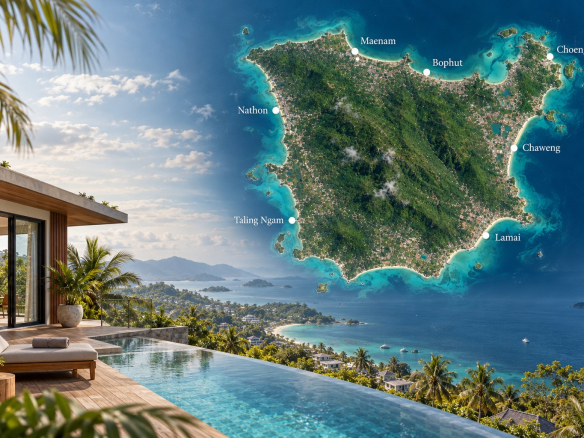

Koh Samui is one of Thailand’s most popular islands for holiday homes, retirement and rental investment – and one of the first questions every international buyer asks is simple: can a foreigner actually buy property in Koh Samui? The short answer is yes, but how you own it depends on the type of property. This guide explains the main ownership options in plain language, the costs involved and the mistakes to avoid.
Note: this article is general information, not legal advice. Laws and their interpretation change, so always work with an independent Thai property lawyer before you buy.
The Basic Rule: Foreigners Cannot Own Land in Their Own Name
Under the Thai Land Code, foreign nationals cannot hold freehold title to land. That does not mean you cannot buy property – it means the structure of the purchase matters. In practice, foreigners in Koh Samui buy through one of the routes below.
Option 1: Foreign Freehold Condominium
A condominium unit is the only property type a foreigner can own outright, in their own name. Under the Condominium Act, up to 49% of the total saleable floor area of a condominium building may be owned by foreigners (the “foreign quota”). The remaining 51% must be owned by Thai nationals or Thai companies.
- Ownership: full freehold title (chanote for the unit), registered at the Land Office in your name.
- Key requirement: the purchase money must be transferred into Thailand from abroad in foreign currency. Your Thai bank then issues a Foreign Exchange Transaction (FET) form or credit confirmation, which the Land Office requires.
- Check first: whether foreign quota is still available in the building. If the foreign quota is full, a unit can only be sold under Thai quota (to a Thai buyer or Thai company) or offered to a foreigner on a leasehold basis.
Browse our condos for sale in Koh Samui, including foreign freehold units in Lamai and Bophut.
Option 2: Leasehold Villa or House
Most villas bought by foreigners in Koh Samui are purchased on a registered leasehold. You own the house (the building) and lease the land underneath it.
- Maximum registered term: 30 years, registered at the Land Office.
- Renewals: contracts often include options to renew for further 30-year periods. Be aware that these renewals are contractual promises, not guaranteed by law – the quality of the contract and the reliability of the lessor matter.
- The building: foreigners can own a building separately from the land, so you can hold the villa itself in your own name, often combined with a registered superficies right.
You may have read about proposals to extend leases to 99 years. As of 2026 this is still a draft proposal, not law – the 30-year limit still applies. See our leasehold properties.
Option 3: Buying Through a Thai Company
Some buyers purchase land and villas through a Thai limited company. This can be legitimate – for example, when the company runs a genuine business such as a rental operation – but it has strict rules:
- A Thai company owning land must be majority Thai-owned, and the Thai shareholders must be genuine investors.
- Using “nominee” Thai shareholders who only lend their names is illegal, and Thai authorities have increased enforcement against nominee structures.
- A company also brings ongoing accounting, audit and tax obligations.
Properties listed under Thai quota – like some condo units – can be bought by Thai nationals or Thai-registered companies. If you are considering this route, get proper legal advice first.
Other Options: Usufruct, Thai Spouse and BOI Investment
- Usufruct: a registered right to use and benefit from land, often for life. Common when a Thai spouse owns the land.
- Thai spouse: a Thai spouse can own land in their own name, but the foreign partner must sign a declaration that the funds belong to the Thai spouse. Plan carefully.
- BOI / 40 million baht route: foreigners who invest at least THB 40 million in qualifying Thai investments may apply for permission to own up to 1 rai of residential land. It is rarely used and approval is not automatic.
What Are the Buying Costs in Koh Samui?
Transfer costs are usually split between buyer and seller by agreement. Typical government fees are:
- Freehold transfer fee: 2% of the Land Office appraised value.
- Specific Business Tax: 3.3% if the seller has owned the property for less than 5 years – otherwise stamp duty of 0.5% applies.
- Withholding tax: paid by the seller, calculated on the appraised value.
- Lease registration: 1% of the total lease amount plus 0.1% stamp duty.
Also budget for legal fees, due diligence and, for condos, the sinking fund and annual common-area fees.
Step-by-Step: How the Buying Process Works
- Choose the property and confirm ownership type (foreign freehold, Thai quota or leasehold).
- Reserve it with a deposit and a reservation agreement.
- Due diligence by your lawyer: title deed, permits, debts, zoning and, for condos, the foreign quota.
- Sign the sale or lease agreement and transfer funds from abroad.
- Register at the Land Office in Koh Samui and pay the transfer fees.
Common Mistakes to Avoid
- Buying land through a nominee structure.
- Relying on unregistered lease “renewals” without proper legal protection.
- Transferring money without the correct FET documentation for a freehold condo.
- Skipping independent due diligence on off-plan developers.
Frequently Asked Questions
Can a foreigner own a villa in Koh Samui?
You can own the building, but not the land in your own name. Most foreigners buy villas on a 30-year registered leasehold.
What is the safest way for a foreigner to buy?
A foreign freehold condominium gives you full ownership in your own name, as long as foreign quota is available.
Can I get a visa by buying property?
Buying property does not automatically give you a visa, but Thailand offers several long-stay visa options, such as retirement, LTR and Thailand Privilege visas, that many buyers use.
Find Your Property in Koh Samui
At My Thai House we help international buyers find the right property and the right ownership structure, and we work with experienced Thai lawyers on every transaction. Explore our freehold properties, browse villas for sale in Koh Samui or contact us for personal advice.